
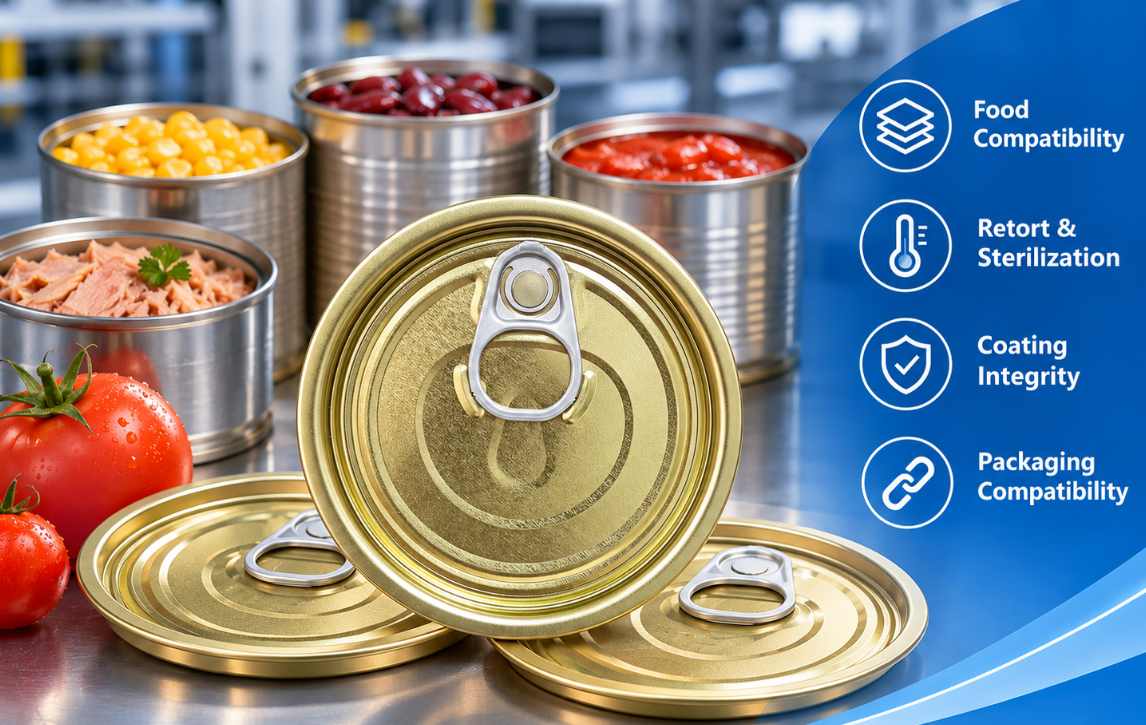
How to Choose the Right Easy Open End Coating for Canned Food
When sourcing tinplate easy open ends for canned food, buyers often begin with the end diameter, material thickness and opening style. However, the internal coating deserves just as much attention. A coating that performs well with one food product may not be suitable for another.
For food manufacturers, choosing the right easy open end coating means considering the food formulation, thermal processing conditions and the complete can packaging system.
Why Does the Internal Coating Matter?
The internal coating forms a protective barrier between the metal substrate and the packaged food. Its purpose is to help limit unwanted interactions that may affect the metal surface, product appearance or package performance.
The coating must also remain suitable for the forming, scoring, seaming and thermal processing conditions associated with the finished easy open end.
For this reason, coating selection should be discussed before commercial production rather than treated as a minor detail after the end size has been confirmed.
1. Start with the Food Being Packed
Different foods create different packaging challenges. Acidity, salt concentration, sulfur-containing compounds, oils and other formulation characteristics may influence coating requirements.
Acidic Foods
Products such as tomato-based foods and certain fruit preparations require particular attention to corrosion resistance and compatibility with the complete packaging system.
Salted or Protein-Rich Foods
Meat, fish and other prepared foods may present different chemical challenges. The appropriate coating system should be evaluated against the actual product formulation and intended shelf life.
Oil-Based Products
For foods packed in oil or sauces, buyers should confirm that the selected coating is suitable for prolonged contact with the product under the expected storage conditions.
There is no single coating specification that should be assumed suitable for every canned food application.
2. Confirm the Retort and Sterilization Conditions
Many canned foods undergo thermal processing after filling and seaming. The coating must be evaluated for the actual processing conditions, including temperature, holding time, pressure profile and cooling procedure.
Buyers should provide their easy open end supplier with the intended processing method rather than requesting a generic "high-temperature resistant" coating.
Coating suitability must be confirmed through appropriate testing of the finished package. A general statement about heat resistance is not a substitute for application-specific validation.
3. Check Coating Integrity Around Critical Areas
An easy open end contains formed features that differ from those of a flat metal sheet. The score line, rivet area, panel profile and surrounding formed regions can place additional demands on coating performance.
During qualification, manufacturers should assess coating coverage and integrity using inspection methods appropriate to the end design and coating system.
The objective is not simply to inspect the appearance of the coating, but to confirm that the finished end meets the agreed requirements.
4. Evaluate the Complete Can-and-End System
Even when an easy open end is produced to the requested dimensions, successful packaging performance depends on its compatibility with the can body and seaming process.
A supplier evaluation should include the end profile, curl dimensions, sealing compound, double seam formation and the performance of the finished package after processing.
The coating should therefore be considered as part of the complete packaging specification, not as an isolated purchasing item.
5. What Should Buyers Ask Their Supplier?
Before approving an easy open end for production, prepare the following information for technical review.
| Information | Why It Matters |
|---|---|
| Food type and formulation | Helps identify relevant chemical compatibility requirements |
| Processing conditions | Supports evaluation of thermal resistance and package performance |
| Can body and end specification | Helps confirm dimensional and seaming compatibility |
| Target shelf life | Provides context for storage and stability testing |
| Destination market | Helps identify applicable food-contact compliance requirements |
| Trial and inspection requirements | Defines the evidence needed before production approval |
Buyers should also request relevant coating documentation, food-contact compliance information and test evidence appropriate to the intended application.
Working with an Experienced Easy Open End Manufacturer
Hongfeng Metal Technology Development (Tianjin) Co., Ltd. is an easy open end manufacturer in China specializing in metal packaging products, including tinplate easy open ends for canned food applications.
When evaluating an easy open end for a new product, our team can discuss the required end specification, food application and processing conditions to support the initial technical review.
Explore our canned food easy open end products or visit the Hongfeng Metal homepage to learn more about our manufacturing capabilities.
Frequently Asked Questions
Can the same easy open end coating be used for all canned foods?
Not necessarily. Coating suitability depends on the food formulation, processing conditions, storage requirements and applicable food-contact regulations.
Does a retort-resistant coating guarantee package performance?
No. The finished package must be validated under the intended processing and storage conditions, including checks relevant to seam integrity and coating performance.
What information should I provide when requesting samples?
Provide the can and end specifications, food type, filling and thermal processing conditions, target market and any required testing or compliance documentation.

