
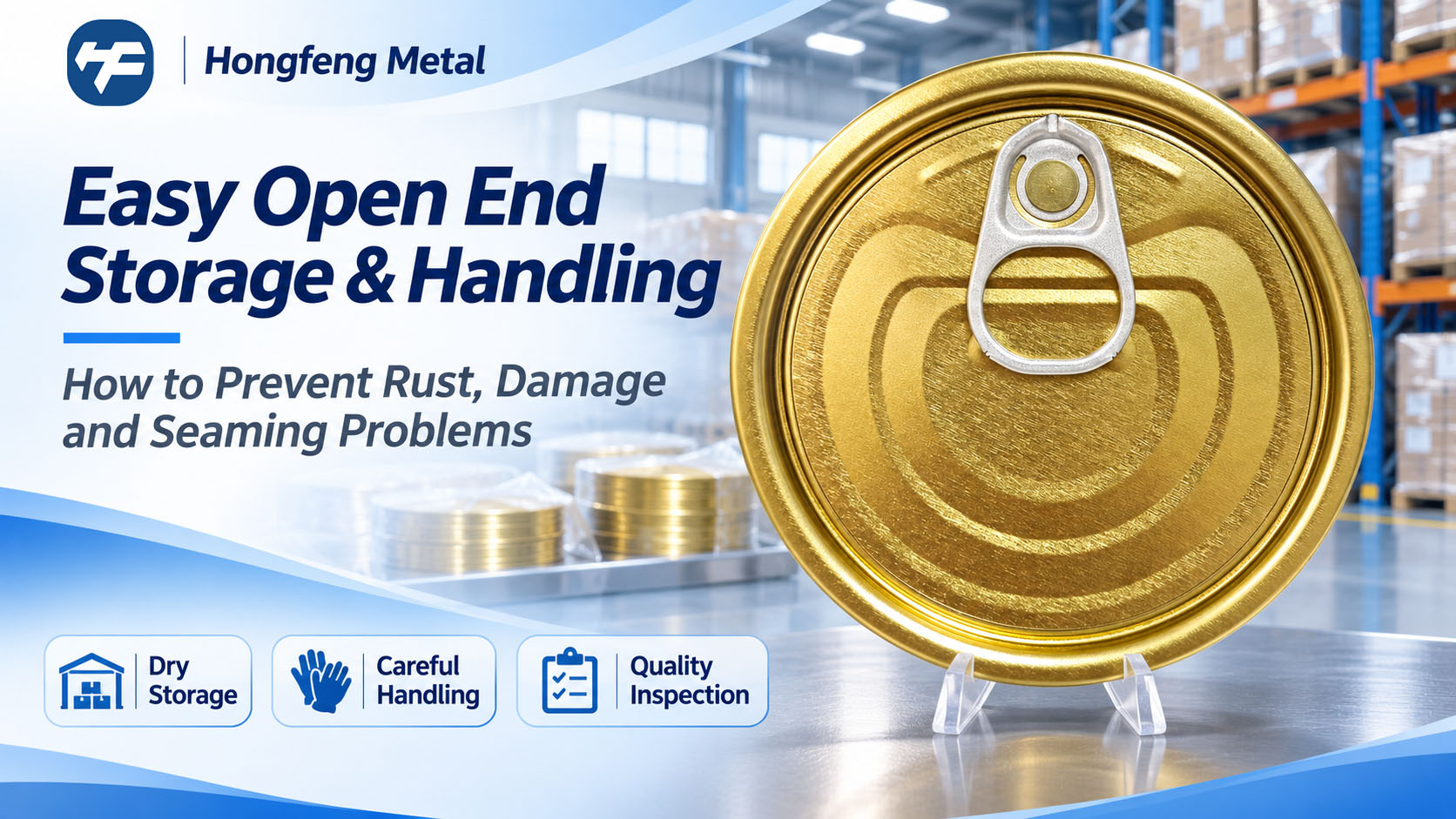
Easy Open End Storage and Handling: How to Prevent Rust, Damage and Seaming Problems
Tinplate easy open ends may arrive at a food can factory in good condition, but their performance can still be affected by what happens between delivery and production. Moisture exposure, rough handling, damaged packaging and incorrect storage practices can create problems long before an end reaches the seaming machine.
For canned food manufacturers and packaging importers, proper easy open end storage is an important part of maintaining product quality. This guide explains the practical checks that can help reduce avoidable damage during international transportation, warehousing and production-line handling.
Why Does Easy Open End Storage Matter?
An easy open end is a precision-formed metal packaging component. Its curled edge, score line, pull-tab assembly, protective coating and sealing compound all contribute to the performance of the finished package.
Although the metal end may appear strong, certain areas can be sensitive to impact, contamination or unsuitable environmental conditions.
A damaged curl can affect double-seam formation. Coating damage may expose metal to corrosion. Dust or foreign material on sealing surfaces may interfere with production.
These risks make storage and handling procedures important for both suppliers and customers.
1. Protect Easy Open Ends from Moisture
Moisture is one of the main concerns when storing tinplate and tin-free steel packaging components. In unsuitable conditions, condensation or prolonged moisture exposure can contribute to corrosion, particularly where protective surfaces have been damaged.
Store easy open ends in a clean, dry and ventilated warehouse according to the approved storage specification. Avoid direct exposure to rain, water leaks and condensation.
Pay Attention to Temperature Changes
International shipments may pass through environments with significantly different temperatures and humidity levels. Rapid temperature changes can create condensation risks, including after a shipment is moved into a warmer warehouse.
If moisture is suspected, inspect the packaging and product condition before releasing the shipment for production.
Do not assume that outer stretch film alone provides complete protection against moisture under every transport or storage condition.
2. Keep Export Cartons and Pallets in Good Condition
Easy open ends are commonly transported using protective cartons and palletized packaging. The purpose of the packaging is to protect the product during loading, ocean freight, unloading and warehouse handling.
Before accepting a shipment, check for:
- Crushed or heavily deformed cartons
- Torn, wet or damaged outer packaging
- Broken or unstable pallets
- Evidence of water entry or condensation
- Unexpected movement or shifting of the load
- Incorrect product identification or batch labels
Damaged outer packaging does not automatically mean every easy open end inside is defective. However, affected cartons should be inspected and assessed before the contents are used.
3. Avoid Deformation of the Curl and End Panel
The curl is one of the most important features of a metal can end because it participates in the formation of the double seam.
If an easy open end is dropped, compressed or handled incorrectly, its curl or panel geometry may be damaged. Such damage can create problems during feeding, positioning or seaming.
Recommended Handling Practices
- Use appropriate equipment when moving palletized ends.
- Avoid dropping cartons or applying excessive pressure.
- Follow the supplier's approved pallet stacking limits.
- Keep products in their protective packaging until needed.
- Separate visibly damaged materials from accepted stock.
Packaging staff should be trained to recognize damaged cartons and suspected deformation rather than transferring all incoming material directly to the production line.
4. Keep Dust and Foreign Materials Away from the Ends
Cleanliness is important when handling easy open ends intended for food packaging.
Dust, loose packaging fragments and other foreign materials can contaminate the end surface or the areas involved in seaming.
Avoid opening more cartons than required for the current production run. When a carton has been partially used, protect the remaining ends using the established handling procedure.
The end-feeding system, nearby work surfaces and storage area should be maintained according to the factory's hygiene and quality procedures.
5. Inspect Easy Open Ends Before Seaming
Incoming inspection provides an opportunity to identify potential problems before they affect the canning process.
The inspection plan should be based on the agreed product specification, the shipment condition, previous quality performance and the customer's approved acceptance criteria.
| Inspection Item | What to Check | Potential Concern |
|---|---|---|
| Outer Packaging | Carton condition, moisture and pallet stability | Possible transportation damage |
| End Curl | Visible deformation and dimensional compliance | Feeding or double-seaming problems |
| Metal Surface | Corrosion, scratches and coating damage | Reduced surface protection |
| Pull Tab and Rivet | Visible damage and required functional checks | Opening-performance problems |
| Cleanliness | Dust, debris and unexpected foreign materials | Contamination or process disruption |
| Product Identification | Model, batch information and specifications | Incorrect material supplied to the line |
Visual inspection is useful, but it does not replace dimensional measurement, seam evaluation or other required quality tests.
If a batch is suspected of being damaged, isolate it until the quality team determines whether it can be accepted, re-inspected or rejected.
6. Maintain Batch Identification and Stock Rotation
For food packaging manufacturers using large quantities of easy open ends, proper inventory management helps prevent unnecessary mixing of different materials or specifications.
Keep the relevant batch information available throughout warehouse storage and production. Use the inventory rotation procedure established for the product and its approved storage life.
Do not assume that an easy open end remains suitable indefinitely simply because the carton has not been opened. Storage duration and conditions should be reviewed against the manufacturer's recommendations.
7. What Should Importers Check After Ocean Freight?
Importers receiving easy open ends after international transportation should establish a consistent delivery acceptance process.
The following sequence can help organize the inspection:
- Check the container and shipment for visible moisture exposure or handling damage.
- Examine the condition of pallets, outer film and cartons before unloading is completed.
- Compare product labels and shipment documentation with the purchase order.
- Identify and isolate any cartons with suspected damage.
- Perform incoming inspection according to the agreed sampling and acceptance procedures.
- Record any nonconformities and contact the supplier with photographs and batch details.
This process can make quality discussions more efficient and help identify whether a problem occurred during manufacturing, transportation, storage or subsequent handling.
Choosing an Easy Open End Manufacturer for International Supply
Reliable international supply involves more than producing an easy open end to the correct dimensions. Packaging protection, product identification, quality documentation and communication with the customer also matter.
Hongfeng Metal Technology Development (Tianjin) Co., Ltd. is a China-based easy open end manufacturer specializing in metal packaging products for the food industry.
Our canned food easy open end range includes multiple round end sizes with material and specification options for different packaging applications.
Buyers planning a new supply arrangement can review our tinplate easy open end purchasing guide for additional considerations before ordering.
Frequently Asked Questions
Can tinplate easy open ends rust during storage?
Corrosion can develop when protective surfaces are compromised and the material is exposed to unsuitable conditions. Dry storage, suitable protective packaging and inspection help reduce this risk.
Can a damaged curl affect the double seam?
Yes. The curl is a critical part of the seaming geometry. Damage or dimensional deviation can affect how the end interacts with the can body and seaming equipment.
Should easy open ends be inspected after shipping?
Yes. Incoming inspection should confirm product identification and evaluate the condition of the packaging and ends according to the approved quality procedure.
Is unopened packaging enough to guarantee product quality?
No. Packaging condition, storage environment, transport history and the relevant product specifications should all be considered.

